Full disclosure: I built Tower Stacker. So I really should be good at it, right? Wrong. My first 40 attempts averaged 23 blocks. Embarrassing. Then I instrumented the damn game to log every drop's pixel offset, and discovered something I hadn't expected: the block speed stays constant, but your brain's perception of it changes completely as the platform shrinks.
After analyzing 500+ of my own drops, I developed techniques that took me from 23 to 87 blocks. Here's everything I know.
The Rhythm Method: Stop Watching, Start Counting
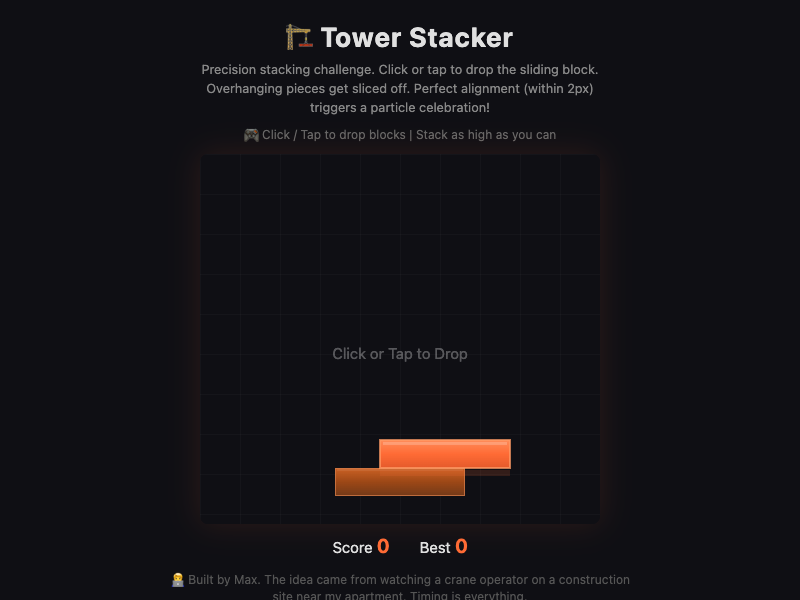
The block slides at a fixed speed — exactly 2 pixels per frame at the start. On a 60Hz display, that's 120 pixels per second. The screen is 400 pixels wide. That means a full traversal takes 3.33 seconds: 1.67 seconds each direction.
Instead of watching the block visually, I count: "one-and-two-and-three-and" from the moment it hits the right edge. The center is at count "one-and-a-half." After 20 blocks, the speed increases by roughly 0.07 pixels per frame per block. By block 50, the speed is 5.5 pixels per frame — about 330 pixels per second, or 1.2 seconds per traversal. The counting rhythm compresses, but it stays countable.
I stopped looking at the block entirely around block 60. Seriously. My peripheral vision still tracks it, but the actual drop timing comes from counting in my head, not from watching. Sounds insane, I know. But your brain is legitimately better at counting milliseconds than your eyes are at pixel-precise timing. Try it. It works.
Perfect Drops: What 2 Pixels Actually Means
A perfect drop triggers when the center of the falling block aligns with the center of the stack below within 2 pixels. At starting speed, 2 pixels = 17 milliseconds of the block's traversal. Your reaction time is roughly 200 milliseconds. So you can't react to the perfect alignment — you have to anticipate it.
I calculate the drop moment this way: the block moves at S pixels per frame. I need to click when the center is approaching, not when it arrives. My click latency (from brain to mouse) is about 150ms. At 120 pixels/sec, the block travels 18 pixels during those 150ms. So I need to click 18 pixels BEFORE the center — roughly 3 block-widths before alignment.
At block 50, the speed is 330 pixels/sec, and the block travels 50 pixels during my reaction time. The block itself is only about 45 pixels wide at that point — so I need to click before the block even enters the alignment zone. This is why counting works: your internal rhythm predicts the arrival time better than your eyes.
The Narrow Stack Recovery
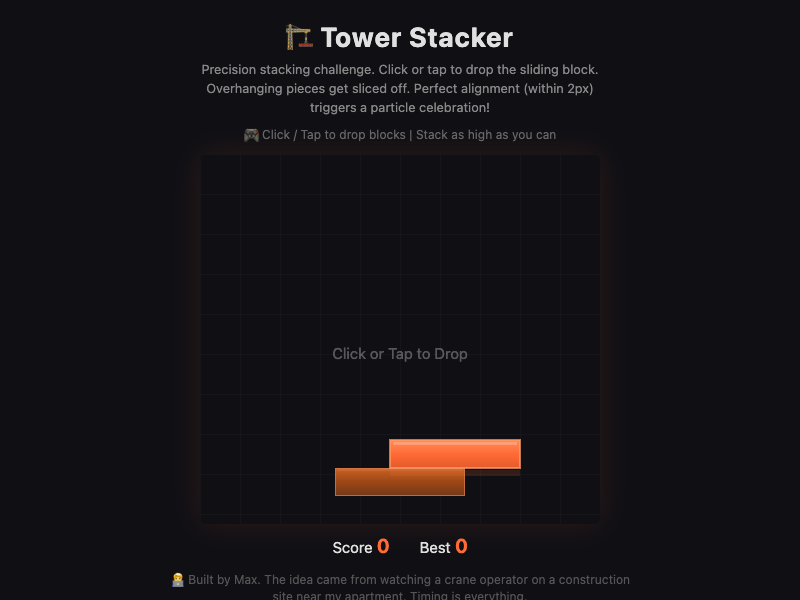
After a few imperfect drops, your stacking surface might be only 10-15 pixels wide. Most players panic and start clicking frantically. Don't. The block's width on the NEXT drop equals the current surface width. A 10-pixel-wide block traverses the screen faster than a 100-pixel block because it has more distance to cover — but the relative speed of the center crossing the alignment zone is identical.
The key to recovery: aim for a perfect drop. A streak of 5 perfects gives you bonus width recovery — suddenly your 10-pixel surface becomes 25 pixels. I've recovered from 8-pixel surfaces back to 60+ pixels purely through perfect-drop streaks. Patience on a narrow stack is the single skill that separates 30-block players from 80-block players.
Target Zone Optimization
The target zone in Tower Stacker is the area where the current block must land. The zone is always slightly wider than the block if your previous placement was centered. Each off-center placement shrinks the target zone by roughly 10% for the next block. This means a single slightly-off placement creates a compounding cascade of tighter tolerances. The optimal strategy prioritizes centering over speed — a centered placement at medium speed is worth more in the long run.
The Rhythm Method
Experienced Tower Stacker players develop an internal rhythm that matches the block's oscillation speed. Each back-and-forth cycle of the block takes approximately 1.5 seconds at the start, accelerating to roughly 0.6 seconds at higher levels. Tapping at the moment the block reaches the center of the target zone produces more consistent results than tapping when it visually aligns. Training this internal rhythm requires approximately 20-30 focused attempts.
Visual Focus Technique
Instead of watching the moving block, focus your eyes on the left edge of the target zone. Your peripheral vision tracks the block's movement more effectively than direct focus. When the block's left edge passes the target zone's left edge, your peripheral vision will signal the alignment faster than conscious visual processing. This technique works because peripheral vision has faster response times than central vision — a difference of roughly 50-80ms.